poems by rachel kellum
to comment ✒️ click on a title
Tapestry
What can you weave
into that beat up rusty door
you found in the barbed wire
arroyo? There’s a hinge,
a corner bent by force,
a strange gill up its length
wind has strummed
for decades. You could
shave your head
and thread the metal loom
with hair. You could mount
the door over a bulb,
let light create a shawl
for a room. You could
poke chicken feathers
through, fragile
reminders of impossible
flight, or gather up
the line of your blues,
that leather cord
strung with shells,
hagstones, sea glass.
You could ignore it,
leave it leaning there,
echo of the wobbly
garden gate, a forgotten
impulse weeds
grow through.
2020
Slow Touch
A woman lies open eyed in the dim morning.
He is finally asleep after another 4 AM waking.
She mostly lets him drift, sometimes
interrupts his snore to wrap an arm around,
across him, until decades of ache drive her
back into solitary postures. Soon, she reaches
again, hand seeking the buried beat inside
his silken chest, places a kiss, another,
on his warm shoulder. He sighs the sigh
that comes from slow touch, manages a turn
to lay his heavy arm across her waist, his hand
somewhere in the void beyond her. She waits
for that hand. Only when bored restlessness
and the clock finally win, when she sits up, pauses,
feet on the chill floor, does he reach to caress
the small of her back or hip poised to stand.
A small investment. They both know she must go.
Perhaps it is similar to the way she calls her mother
when she is driving toward mountains, knowing
she will lose signal soon and the conversation
has a sure expiration, will not wander on for hours,
her mother’s retelling tales of loss and longing,
ever etching grooves—waiting to be played, waiting
for the needle to drop—on her daughter’s body.
Mountain Monsoon
Loud seconds turned ten minutes white.
Ice marbles shredded pines, and hundreds,
no, many thousands of tiny piñon cones
dropped like fists across flagstone paths
and bounced in drunken dance with hail
through carefully tended beds. Blood roses,
poppies, lilies, coneflowers, daisies,
hollyhocks, pots of mint, tomato, petunias,
basil, sage—all torn, bruised, deflowered
by odd stones, assault tangled up in rain
and new needles, everything now a sodden,
sad mulch. The quadrennial promise of pine
nuts lost—days later, ragged hands of hostas
raised a stand of pale poles. Purple buds
hung limp above green tatters, never bloomed
in surrender. Fire ants collected their nectar.
Ode to My Old Shovel
After admiring Fred’s—a thin,
stubby-bladed thing
that cut just deep enough,
freeing up a perfect scoop
of manageable dirt
my softening arms could heft
without undo sweat or back
damage—the old farmer
told me I could likely find one
in the junk store
across the tracks, owned
by a local hoarder
who turned her piles of pots,
clothes, games, lamps,
tarnished antique spoons,
vintage knick knacks,
candy dishes and early 20th
century shovels into cash.
I did. There it was in the back
corner of the dim building,
cobwebbed, silently sifting
dust with other forgotten,
slim implements, rusted brown,
all of them leaning
against walls and each other
like a morning lit table
of retired farmers sipping coffee,
gossiping, reminiscing
the sweet promise of rain
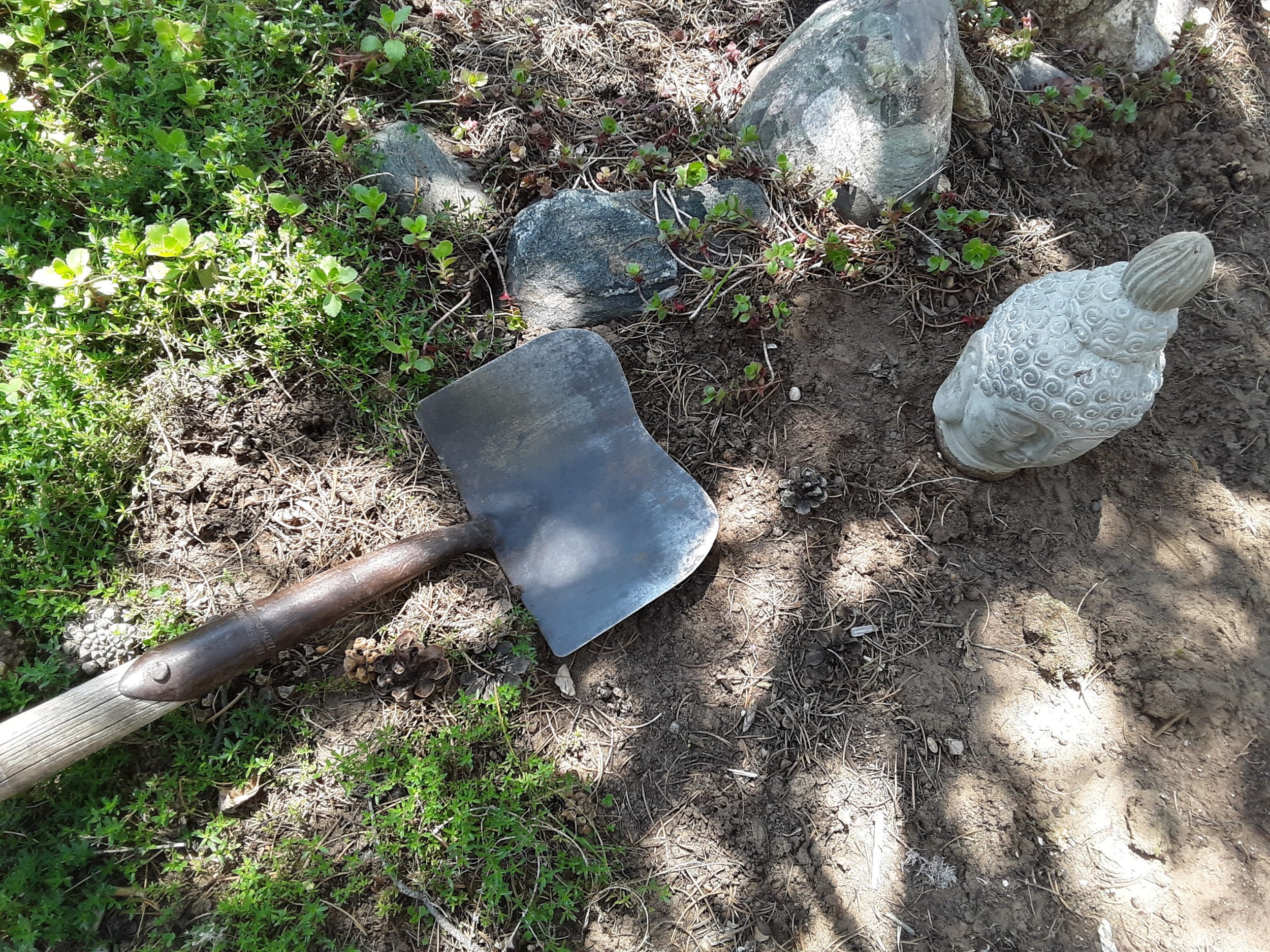
in the nose. How to describe
this beauty? Wood handle
weather-grooved but still tight,
easy to replace, gripless.
Like Fred’s, the stepless,
long-collared blade
is extra thin and strangely shallow,
its mysterious, misshapen tip:
purposely forged? or—
workworn down to a gentle
inverse curve, exactly opposite
the pointed end you’d expect,
not unlike a slice
of homemade bread,
yin to a new shovel’s yang,
as if a young man,
this woman, could slowly smith
the perfect tool
against the fire inside
a sweaty cotton shirt,
file it in the giving grit
of simple earth.
with gratitude to my old neighbor and friend,
Fred Wahlert of Brush, Colorado
Roommates
Hildegard is seventeen, or maybe six-.
She helped me raise three kids,
watched men come and go, hissed
either way: hello, good riddance.
Like true roommates, we don’t kiss
or cuddle. Sadly, I’m slightly allergic
so only scratch her ears and chin,
tolerate her needled love nips,
wash before I touch my eyes and itch,
periodically brush her coat, let her in
and out to prowl night’s holey pockets
and ward off that other cat who likes to piss
on our threshold. Little bitch. Hilde
knows I love her: I scoop her shit,
meow back when she wants to chit
chat, don’t scold when I step in her vomit.
Like me, she’s gotten fat, likes to sit
upright like old Hotei and slowly lick
her round belly. It swings when she skits
across the floor, and her eyes, sky slits,
are fading strangely: ghostly, distant.
Perhaps she’s going blind, but not decrepit,
not yet. Last week, before a 5 day trip,
she went missing getting her night fix.
I meowed from the porch, across the mint,
and she returned the call from her pit
beneath the porch, behind the lattice.
Her eyes burned yellow, that spectral glint
of flashlight. Here, kitty, kitty. She wouldn’t.
Under the steps, on sore knees, I flashlit
my waggling finger tips, luring her with
touch. That is all it took. She came, slid
against my sharp edges, her catnip.

Hagstone

On the beach we all have a knack for something.
My son in law skips stones six leaps across a thinning surf.
My husband harbors inner heat despite the wind.
With ease I find black stones with holes clear through
where witches live, my daughter says, and laughs.
Her gifted ears are fine tuned to tumbling staffs
of waves crashing in multi-phonic whispers and roars.
Harmonics hum along this stretch of sand, lost on me.
My ever gulping pupils ignore my poor ears, grow
lost in mirages of hands and feet burning in the campfire,
wood mimicking bone, an archeology of grain
that striates everything, as though the whole
earth were breathing inside a set of giant, fractal ribs
spinning out the endless chests of gulls, men, fish,
metastasized hotels, pretty cages glowing along
the coast like mammoth corpses or gum-receded teeth.
Red logs remind me how many degrees my bones
will reach on the path to ash, ash my family may choose
to suspend in blown glass, spun globes to place on desks
as paperweights, or shelves as funerary art or shrines
beneath thangkas of Tapihritsa where I may serve
as a reminder, a gutted clock. Perched on a mirror base,
plugged in, LED lit, five alternating colored lights
shining through what’s left of me, a tiny spiral galaxy—
starry crumbs of my body glowing in vitreous space
like Tibetan thigles—to everyone’s surprise I will be
not quite a comfort, not quite discomfiting.
Matroyshka Dolls
for my mother
So many memories I can’t access but know.
I still own the I Can Read books you read to me--
flyleaf scrawled with my name in child’s careful cursive,
saved to read a thousand times to my kids--
but not the viscera of your voice reading them.
It is a small tragedy. Cosmic irony.
I have passed my voice through books
in endless silly accents against the truth
my children will forget my voice too.
This perhaps is the great loneliness
of motherhood: to be the only one to remember
the dream of raising a child raising you
into invisible servitude, constant, busy solitude.
How hard you try to hide the struggle,
remember where you buried the bone
of yourself, avoid the fall into empty holes.
As a mother forgets her own mouth
on her mother’s breast, so do her children
forget the lullabies she sang, thousands of meals,
imaginative games, lessons on magical rocks,
nearly every reassuring caress, except the ones
bookmarked by chronic, irreparable loss.
Doll. House. Family. Father.
Mother, I don’t remember
every bedtime, but my heart recalls them all
as one grand, archetypal Tuck In, complete
with prayer. The reverence of your voice,
its cadence washing over, eroding worry,
rhyming with every helpless mother’s prayer.
I know that ancient language in my cells.
Everything else is fog. We forget
our deepest happiness like we forget air.
I don’t remember being an egg in your body.
Small, quiet moon tucked inside the tiny nest
of your fetal ovary. Together we floated,
little astronauts, two Russian dolls
stacked inside your mother’s body.
I can’t remember, but I know.
We’ve been together from the beginning.
Instead of Children
Asleep I dream of clay and children
and not enough time
to show them how to fully open the eyes
of the hands, the fingers of the eyes.
Awake I dream of clay instead of children
and not enough time
to fully perform my own concerto, lucid fingers
bowing from silence
innate melodies of mud and fire into mugs
that become children.
deep end
slick and sharp
as a new needle, as a girl
I forced myself
to jump feet first
incremental courage
nine feet, sixteen, thirty-three
pinching my nose
eyes clenched closed
belly coiling velocity
life rushed up stories
to swallow my inches
how we must live
stitching sky and water
to earth, back up for air
stitching us all together
we who don’t belong
to each other, miles
of unknotted thread
trailing behind every dive
releasing the seam years
and years behind me
Dog Psalms
1. God stares out the window for hours, surveying His domain. Everything smells of Him. He waits.
2. God wants to find a good, fresh bone on His walk, perhaps a tibia attached to a knee, still sour sweet. If he’s lucky, He can sneak it into the house before I close the door, curl up with it on His bed and chew Himself into a dream of a yipping chase in which He, exploding from His hiding place, lands His teeth exactly on a leg and wakes to find it so.
3. God is always begging to be scratched, to leave His musk upon my hands and through me touch the world.
4. God longs for a grungy god-couch upon which He can lie with me, kneading His silken ears, our hearts aligned, my morning breath and distant crotch thrilling His modest, omnipotent nose with my story of love and loss, and through my sorrow penetrate my soul. Perhaps you already know: God is an olfactory historian, a healer, a pleaser, a connoisseur of forgiveness.
5. God has brown eyes. I cradle His slim face. We take each other in, unblinking, oxytocin surging, mutual medicine.
6. Every evening, God begs me to walk with Him. When I emerge from the closet in my unwashed walking jeans, He smells what is in store. It sends Him into frenzy. He dances back and forth between me and my husband, a reluctant walker after a long day of work. Egging, wiggle-begging in ecstatic downward-god pose, He prances, tosses His head toward the door. Come on!
7. Tired as we are, we go with God.
with thanks to Rilke for the phrases explodes from his hiding place and the modesty to use sorrow in order to penetrate our soul